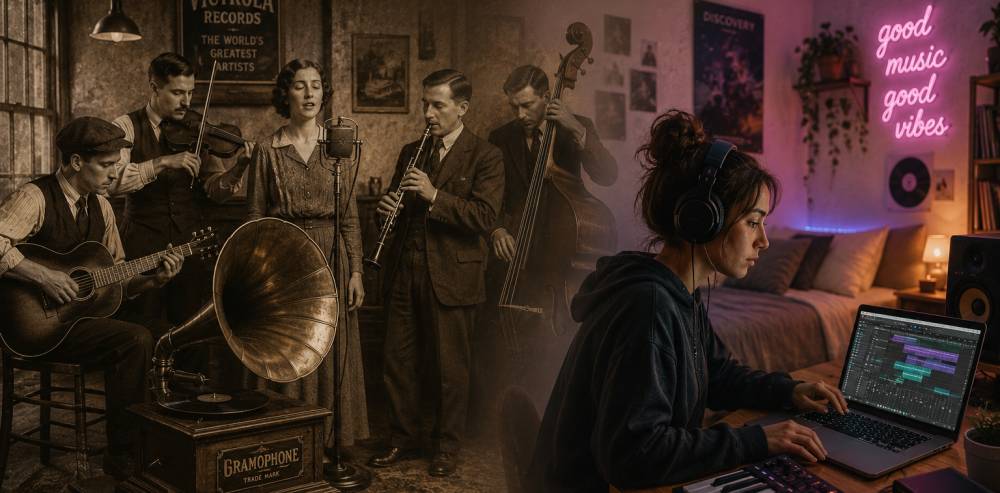
How technology transformed the way songs are made — from musicians gathered around a single microphone to entire studios inside a laptop.
Before we hear a song, there is an entire process hidden behind it.
The recording equipment. The producer shaping the sound. The decisions that turn a simple idea into a finished track.
For most of music history, creating a record required expensive studios, specialist engineers and rooms filled with equipment. I remember plugging dozens of ¼ inch cables into various patch panels to link different rack mounted modules together. Today, a laptop, a microphone and the right software can give almost anyone the ability to create music heard around the world.
The tools have changed dramatically, but the goal has always stayed the same: capturing a feeling.
The First Recordings: Capturing a Moment
My last article covered the first recording machines that appeared in the late 1800s, music production as we know it did not really exist.
Recording was simply about capturing a live performance.
Musicians would gather around a machine and play together, with no ability to fix mistakes, change arrangements or adjust the sound afterwards. The recording was a snapshot of a single moment.
There was no editing, no effects and no second chances.
The Studio Becomes Part of the Music
The introduction of magnetic tape changed everything.
For the first time, recordings could be edited, copied and manipulated. Producers could combine different performances, experiment with sounds and shape the end result.
The studio was no longer just a place where music was recorded, it became an instrument.
By the 1960s, artists and producers were using recording technology creatively, layering sounds and experimenting with effects. Albums were no longer simply live performances captured on tape — they became carefully constructed pieces of art and the producer became a creative force.
The Multi-Track Revolution
Multi-track recording transformed the way musicians worked.
Instead of an entire band recording at once, individual parts could be captured separately and mixed together later.
Drums, bass, guitar, vocals, very element could be adjusted, improved and rearranged.
This gave producers unprecedented control and opened the door for new styles of music. The recording process itself became part of the creative journey.
Synths, Machines and New Sounds
The arrival of electronic instruments in the 1970s and 1980s created another revolution.
Synthesizers, drum machines and sequencers allowed musicians to create sounds that had never existed before and genres such as electronic music and synth-pop were built around these new possibilities. The machines became part of the band.
Music was no longer limited by traditional instruments, sound itselfbecame something that could be designed.
The Digital Studio Arrives
The biggest change came when recording moved into the computer.
Digital Audio Workstations (DAW’s) allowed producers to record, edit and mix entire songs using software. Expensive studio equipment that once cost thousands could now be recreated virtually.
The studio was no longer necessarily a building, it could be a bedroom!
This created a new generation of independent artists who could make professional-quality music without record labels, major studios or huge budgets.
The barriers to entry disappeared.
The Bedroom Producer Era
The internet accelerated the change.
Online tutorials, affordable software and digital distribution allowed creators to share music directly with listeners across the world. A song made at home could now reach millions of people.
Collaboration became global. New genres developed faster than ever and producers became artists in their own right.
Music creation was no longer controlled by a small group of industry professionals, anyone could start creating.
The AI Question
Today, the next major shift is already arriving.
Artificial intelligence is beginning to influence music production, helping with everything from generating sounds to assisting with mixing and creative ideas.
As with every major technological change, it has created debate.
Will AI replace musicians?
Or will it simply become another tool, like the microphone, synthesizer and computer before it?
History suggests that technology does not remove creativity — it changes the way creativity happens and I am going to talk about this in the next piece.